
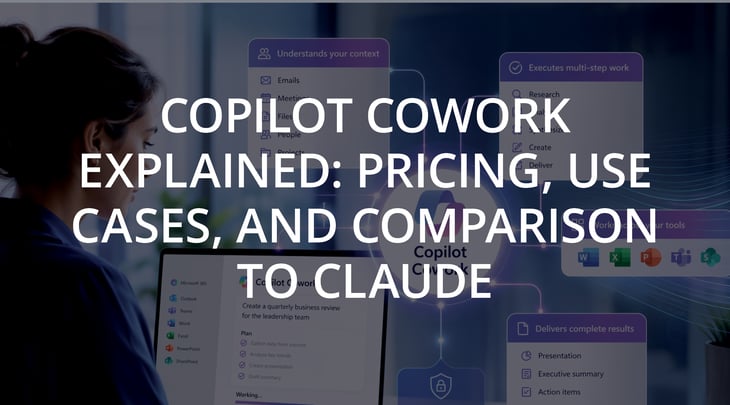
Microsoft just announced the general availability of Copilot Cowork, and it represents an important shift in how organizations use AI at work.
Until now, most AI value has focused on helping individuals move faster. Drafting emails. Summarizing meetings. Creating content. That value is real, and many organizations are already seeing it with Microsoft 365 Copilot.
Copilot Cowork builds on that foundation and moves AI from assisting work to actually executing it.
What is Copilot Cowork?
Copilot Cowork is an agentic AI capability that allows organizations to delegate multi-step work and have AI execute it across systems, data, and applications.
Key shift: Copilot moves from generating responses → delivering outcomes
From assistance to execution
Traditional Copilot experiences are great for point-in-time tasks. You ask a question, get a response, and move forward. If you are early in your AI journey, this is where most organizations start with Microsoft 365 Copilot. Copilot Cowork introduces something different. It allows you to delegate meaningful, multi-step work and have AI carry it through to completion across your tools, files, and systems. Instead of prompting step by step, you describe the outcome you want and let AI execute against it.
- Breaks work into logical steps
- Reasons across your data and applications
- Executes tasks over time
- Produces complete deliverables
➡️ Bottom line: AI becomes an execution layer, not just a tool.
How Copilot Cowork Executes Work
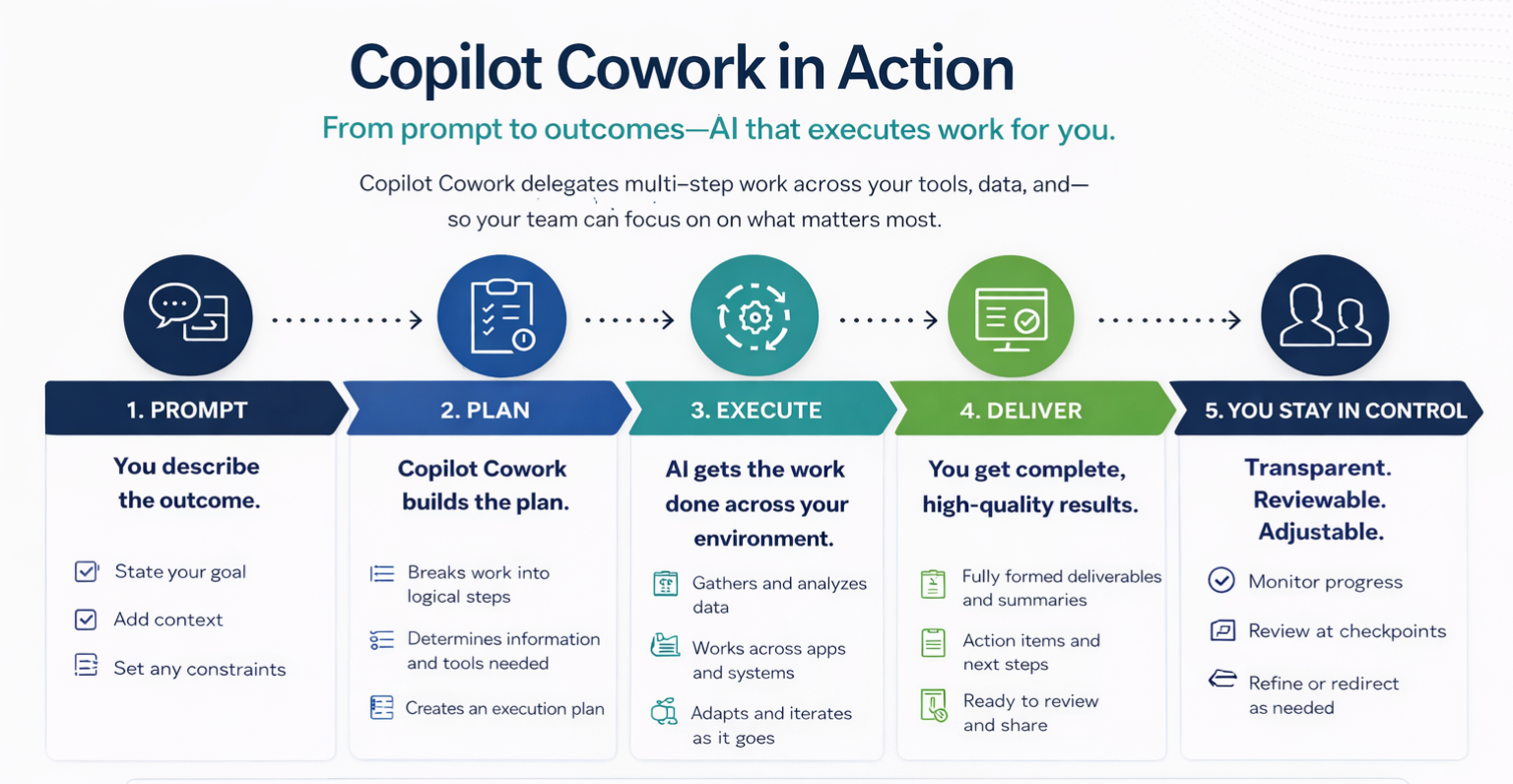
Caption: Copilot Cowork transforms a prompt into a structured workflow that delivers complete outcomes while keeping your team in control.
What makes Copilot Cowork different
1. It executes real work
Not just responses. It plans and completes workflows.
2. It understands your business context
Grounded in Work IQ, it connects data, relationships, and workflows.
3. It spans apps and time
Work continues beyond a single interaction.
4. It remains controllable
You can monitor, guide, and adjust execution.
5. It is enterprise-ready
Security, identity, and governance are built in.
When to use Copilot Cowork
- Copilot Chat → quick help
- Microsoft 365 Copilot → in-app productivity
- Copilot Cowork → multi-step execution
Use Cowork when work spans systems, steps, and deliverables.
A shift in how organizations think about AI
This is not just a product update. It is a shift in how AI is used inside the business. We are moving from:
- AI helping individuals complete tasks
To:
- AI executing business processes alongside your team
Understanding the shift to usage-based billing
Copilot Cowork introduces usage-based billing layered on top of Microsoft 365 Copilot licensing. As AI moves into execution:
- Cost reflects work completed
- Usage scales with automation
- AI becomes tied to outcomes
This is enabled through Copilot Credits.
What this means
- Pay for outcomes, not just access
- Costs scale with usage
- Governance becomes essential
- Advanced automation becomes practical
👉 Learn more about how we help customers manage this with our Copilot advisory and deployment services
Copilot Cowork vs. Claude Cowork: comparison
| Category | Microsoft Copilot Cowork | Claude Cowork (Enterprise) |
| Base pricing model | M365 Copilot license + usage billing | Seat license + usage billing |
| License includes | AI across Microsoft 365 apps | Claude platform access with Cowork |
| Usage billing | Credits based on work executed | Token-based consumption |
| Usage included | Core included, execution billed | Minimal included usage |
| Cost predictability | Hybrid model | Primarily consumption-based |
| Scaling driver | Workflow complexity | Tokens consumed |
| Enterprise agreements | Integrated with Microsoft ecosystem | Often includes usage commitments |
| Best fit | Microsoft-centric organizations | Cross-platform environments |
What this means for customers
High-value use cases include:
- Sales workflows
- Financial reporting
- HR coordination
- Executive preparation
These are multi-step, cross-system processes.
Where to start
- Identify high-value workflows
- Map AI execution opportunities
- Set cost guardrails
- Pilot use cases
Final thoughts
We are moving from:
- Asking AI for help
To:
- Assigning AI responsibility
Usage-based pricing reflects that shift.AI is becoming an execution layer across the business.
The move to usage-based billing reflects that shift. AI is becoming an execution layer across the business.
If you are evaluating what this looks like in your organization, Interlink helps you identify the right starting point and build a plan to scale AI responsibly.